



Flying with camera batteries, drone batteries, and power banks looks simple until you're standing at a TSA checkpoint trying to remember whether your 100-watt-hour cap includes the battery in your camera or just the spares in your bag. The rules are not complicated once you know them, but they are specific, and getting them wrong can mean a confiscated battery, a missed flight, or — increasingly in 2026 — a fine.
This guide expands on the basics with the actual watt-hour math, airline-by-airline comparisons, a reference table of common camera and drone battery capacities, and the security-checkpoint procedure that trips up even experienced traveling creators.
The Core Rule: It's All About Watt-Hours
Every lithium-ion battery rule traces back to one number: watt-hours (Wh). The Federal Aviation Administration and the Transportation Security Administration both regulate spare lithium-ion batteries using the same three-tier structure, and most international carriers follow the equivalent IATA framework.
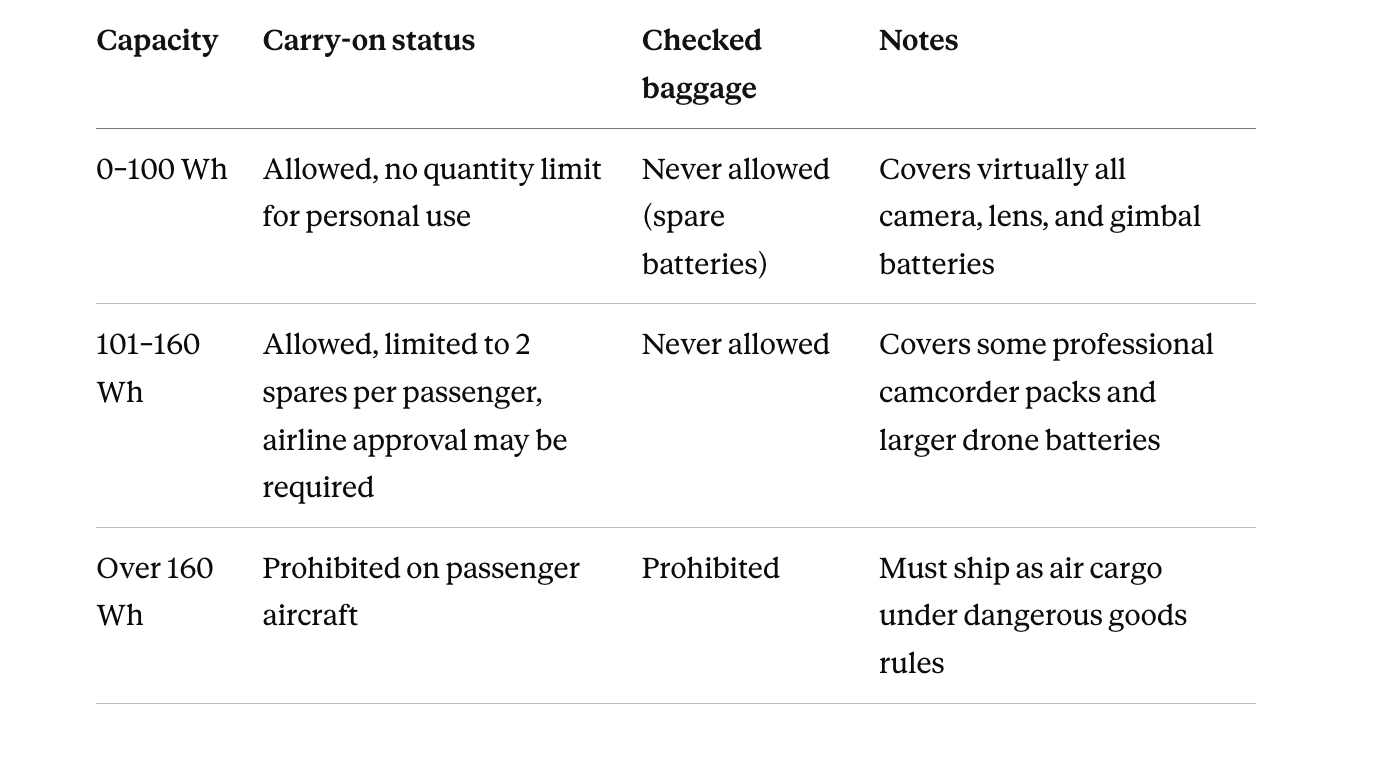
The FAA confirms this directly: rechargeable batteries with a capacity of 0-100 watt-hours are allowed on passenger aircraft, while those with a capacity of 101-160 watt-hours require approval from the air carrier, and batteries exceeding 160 watt-hours are forbidden. For the 101–160 Wh tier specifically, there is a limit of two spare batteries per person.
If your battery isn't labeled with its Wh rating, you can calculate it yourself. The FAA's own formula: to determine watt-hours, multiply the volts by the amp hours. For example, a 12-volt battery rated to 8 amp-hours is rated at 96 watt-hours. If your battery is labeled in milliamp-hours (mAh) instead, divide by 1,000 to get amp-hours first, then multiply by voltage.
Quick formula: Wh = (mAh ÷ 1,000) × V
Battery Type Breakdown
Not all batteries in a video kit are treated identically. The two categories that matter for air travel:
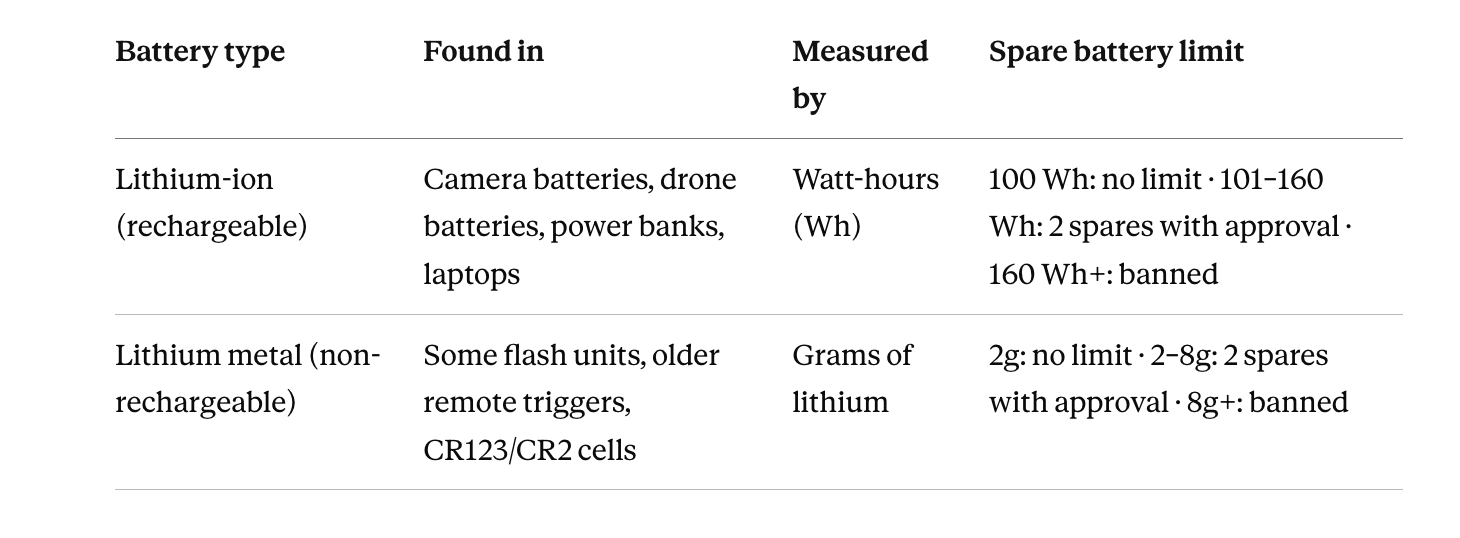
A useful equivalence: 100 Wh of lithium-ion capacity is roughly the same risk threshold as 2 grams of lithium metal, and 160 Wh lines up with roughly 8 grams. Most consumer flash batteries (AA, CR2) and remote-trigger coin cells fall nowhere near these limits and aren't worth worrying about — the watt-hour rules exist for rechargeable packs with real stored energy.
Camera Battery Reference: How Close Are You to the Limit?
This is the part that surprises most photographers and videographers: almost no camera battery on the market comes anywhere close to the 100 Wh threshold. The rules were written with laptop batteries, e-bike packs, and drone batteries in mind — not the small cells inside a mirrorless camera.
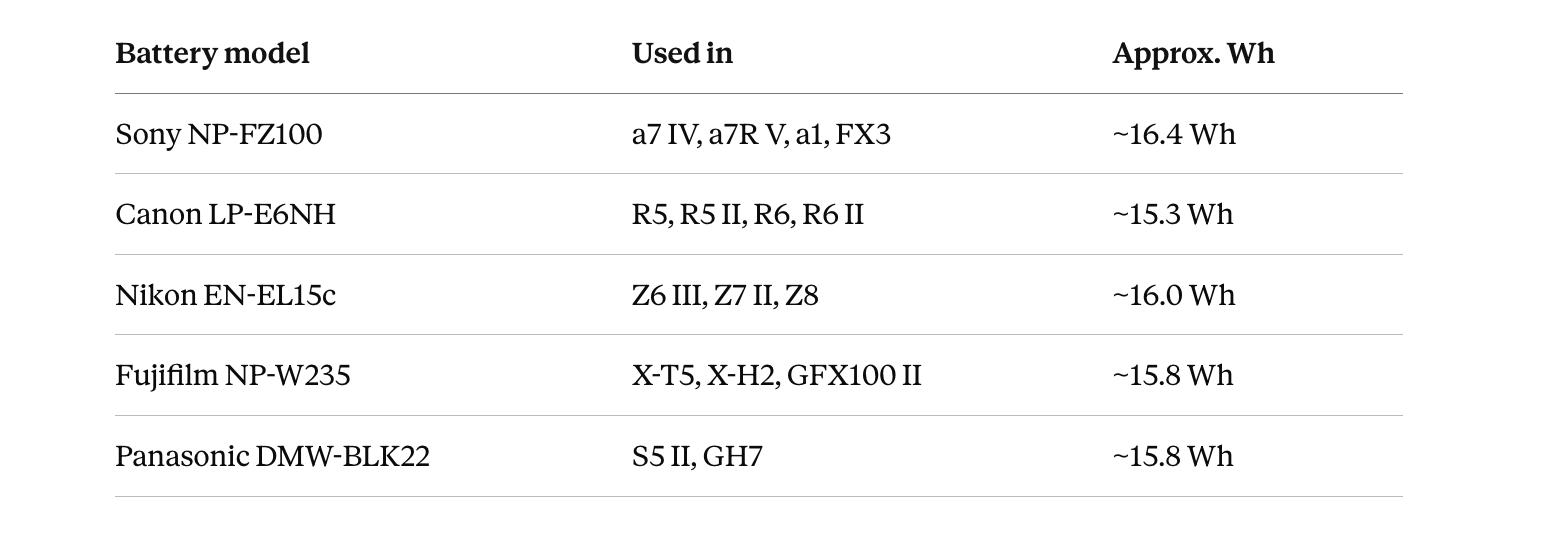
These figures come from manufacturer specs and are calculated as Wh = mAh × V ÷ 1000. Carrying four spares of any of these batteries puts you at roughly 60–66 Wh total — well inside the carry-on limit even before considering that the 100 Wh cap applies per battery, not cumulatively, for the under-100 Wh tier.
One emerging wrinkle: newer USB-C-rechargeable camera batteries (some recent Sony, Canon, and Insta360 models) occasionally get flagged by security screeners as "power banks" because of the charging port, even though they're regulated identically to any other camera battery. Keeping the battery in a labeled case, or carrying a printed spec sheet showing the Wh rating, resolves this quickly if it comes up.
Drone Batteries: Where the Limit Actually Matters
Drone batteries are the category most likely to push you toward — or past — the regulatory thresholds, since flight batteries pack far more energy than a stills camera battery.
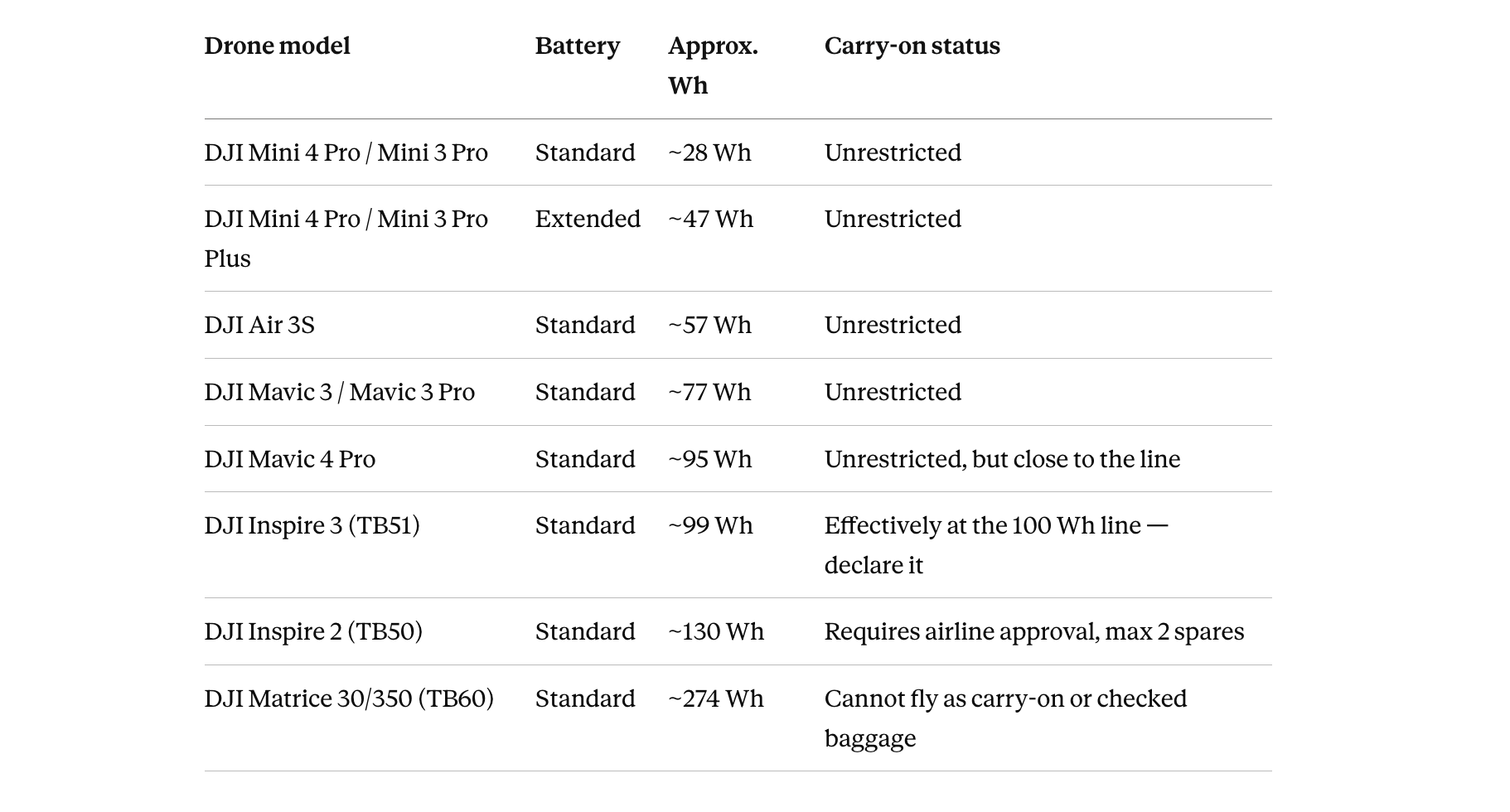
For FPV and freestyle pilots running LiPo packs rather than branded drone batteries: most 4S racing packs (1,300–1,800 mAh) land around 20–30 Wh, and 6S freestyle packs (1,800–2,200 mAh) land around 40–50 Wh — both comfortably under the limit.
The packs to watch are 6S/8S long-range batteries above roughly 3,500 mAh, which can cross 100 Wh. Run the math before you pack, using nominal cell voltage (3.7V per cell for standard LiPo chemistry, so a 6S pack is calculated at 22.2V nominal).
Whatever the Wh rating, drone batteries follow the same carry-on-only rule as every other spare lithium-ion battery — there's no exception for batteries installed in equipment versus loose spares when it comes to checked baggage. Spares must travel with you in the cabin.
Power Banks: A Separate, Increasingly Strict Category
Power banks deserve their own section because the rules around them have tightened meaningfully and because video creators often carry one or two to keep cameras and monitors running during long shoot days.
The general carry-on threshold for power banks is identical to camera batteries: up to 100 Wh travels freely, 101–160 Wh requires airline approval and is capped at two units, and anything above 160 Wh is banned outright. As one industry summary puts it, every major airline and TSA follow the same lithium-ion rule: portable chargers up to 100 watt-hours are allowed in carry-on luggage, and chargers must travel in carry-on, never checked baggage.
A handy reference point: 100 Wh works out to roughly 27,000 mAh at the standard 3.7V nominal voltage power banks use, so a 5,000 mAh charger is approximately 18.5 watt-hours, a 10,000 mAh charger is about 37 watt-hours, and a 27,000 mAh charger is around 100 watt-hours.
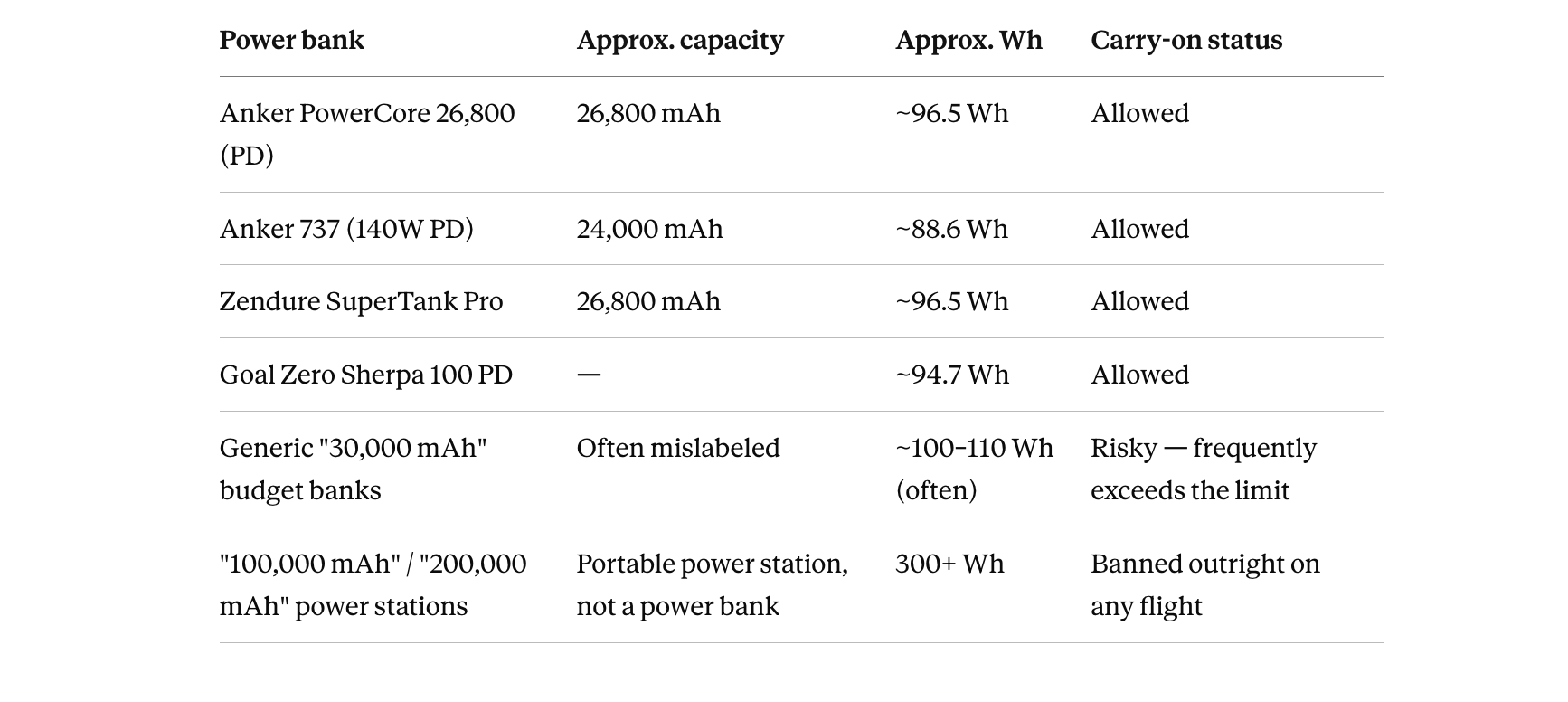
American Airlines' New Power Bank Rule (Effective May 1, 2026)
In the most significant recent policy shift, American Airlines introduced a power-bank-specific restriction that goes beyond the standard Wh framework. After the FAA recorded a sharp rise in onboard battery incidents, American capped passengers at two power banks, both under 100 Wh, with additional handling requirements:
- Maximum two power banks per passenger, each under 100 Wh
- Carry-on only, and the power bank must stay accessible — not stowed in the overhead bin
- No in-flight charging from a power bank, even at your seat; use the aircraft's power outlet instead
This rule was introduced because, per the FAA, 97 lithium-battery incidents occurred on US aircraft in 2025, mostly involving cheap power banks overheating mid-flight. Importantly, the policy is narrowly targeted: it affects loose power banks specifically and does not change the existing camera-battery or drone-battery allowances. American still permits up to four spare lithium-ion batteries under 100 Wh and two spare batteries between 100 and 160 Wh with approval — which covers essentially every camera and consumer drone battery on the market.
As of mid-2026, other major US carriers have not matched this policy. Delta, United, and Southwest still operate under the standard FAA framework, which allows up to 20 spare batteries under 100 Wh per passenger and does not specifically cap power banks. Given that American made a similar unilateral move with laptop-in-checked-bag rules back in 2017 before the rest of the industry followed within a year, it's reasonable to expect other carriers to introduce comparable power bank limits later in 2026.
Airline Policy Comparison
Because individual airlines can apply stricter rules than the regulatory baseline, always check the specific carrier before a trip. Here's how the major US carriers compared as of mid-2026:
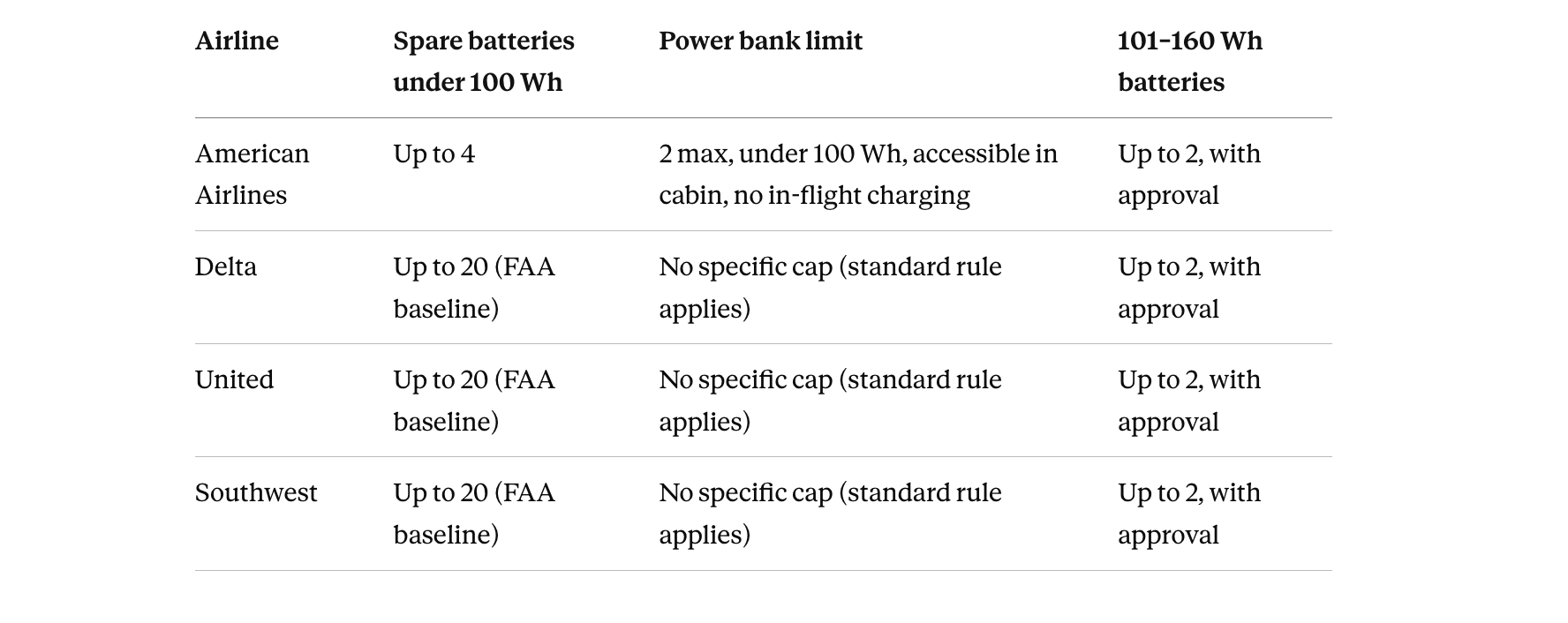
International carriers generally track the IATA standard rather than any single country's domestic rules. As CineD's filmmaker-focused coverage notes, IATA's broader guidance suggests up to 20 spare batteries per passenger, while spares between 100 and 160 watt-hours are universally capped at two per passenger and require airline approval, and anything above 160 watt-hours remains banned outright and must move as cargo under hazmat shipping rules. Most European and Asian carriers already enforce this framework, meaning a trip that starts on a US domestic carrier and connects to an international one may involve two different rule sets in the same itinerary — always check both.
Packing Batteries Correctly
Beyond watt-hour limits, how you physically pack batteries affects both safety and how smoothly you get through screening.
- Keep batteries in their original retail packaging where possible, since this typically provides terminal protection by design.
- If you've removed batteries from their packaging, use individual battery cases, a dedicated LiPo-safe pouch, or simply tape over the terminals so they can't contact metal objects like keys, coins, or other batteries.
- Pack spare batteries in your personal item or the bag you're keeping at your seat, not the bag most likely to be gate-checked.
- For drone batteries specifically, remove them from the aircraft before packing the airframe, and carry the batteries separately in a protective pouch.
- IATA's safety guidance reinforces this directly: keep spare batteries and power banks in their original packaging, or cover the terminals with tape to prevent short-circuits.
The Gate-Check Risk
One scenario catches frequent flyers off guard: your carry-on gets gate-checked because the overhead bins are full. If that happens with spare batteries inside, you have a problem, since spare batteries can never travel in the cargo hold. IATA's guidance is explicit on this: if your hand baggage is taken at the gate to go in the aircraft cargo hold, you must remove all lithium batteries and devices first.
The practical takeaway: keep spare batteries and power banks in a smaller bag that fits under the seat in front of you, separate from your main carry-on. That way, if your larger bag does get gate-checked, your batteries are already where they need to be.
What Happens at Security
The screening process for batteries is straightforward, but skipping it can cause delays.
- Remove spare batteries and power banks from your bag before they go through the X-ray.
- Place them in a separate bin, similar to how you'd handle a laptop.
- If asked, be ready to state the Wh rating, especially for anything in the 80–160 Wh range where an agent might want to confirm it's within limits.
- For batteries in the 101–160 Wh range, carry documentation of airline approval if your airline requires pre-clearance.
Security agencies recommend proactive disclosure rather than waiting to be asked. As one battery safety resource notes, it's recommended to inform security officers proactively about spare batteries, since some airports require an explicit declaration.
Enforcement and Penalties in 2026
Battery rule enforcement has become noticeably stricter. According to a 2026 regulatory summary, current consequences for non-compliance include confiscation of prohibited batteries (which, once seized, are not returned), civil penalties for hazardous materials violations — particularly for undeclared batteries — and additional security screening for passengers with repeat violations. The same source highlights that gate-check procedures now explicitly require battery removal before a bag enters the cargo hold, and that smart luggage with non-removable batteries can be denied boarding entirely.
This is a meaningful shift from a few years ago, when an improperly packed battery was more likely to result in a polite redirect than a fine. Treat the watt-hour limits and packing requirements as firm operational rules, not loose guidelines.
Quick Pre-Flight Checklist
- Calculate the Wh rating for every battery you're not sure about (Wh = mAh ÷ 1,000 × V)
- Confirm your specific airline's spare battery and power bank limits — don't assume the FAA baseline applies
- Pack all spare batteries and power banks in carry-on only, never in a bag destined for the checked hold
- Tape terminals or use protective cases for any loose batteries
- Separate batteries into an easily-accessible pouch in case your main bag is gate-checked
- Remove batteries from drones before packing the airframe
- If carrying 101–160 Wh batteries, get airline approval in writing before you travel
- Leave anything over 160 Wh — including most portable power stations — at home, and ship or rent instead
- Be ready to declare batteries and state Wh ratings at the security checkpoint
Conclusion
The fundamentals haven't changed: lithium-ion batteries belong in carry-on luggage, the 100/160 watt-hour tiers determine what you can bring and how much airline paperwork you'll need, and proper terminal protection prevents both fires and arguments at security. What has changed in 2026 is the level of scrutiny. With the FAA tracking a rising number of in-flight battery incidents and at least one major carrier already tightening power bank rules beyond the federal baseline, the safest approach for any videographer or content creator is to check your specific airline's current policy before every trip, know the exact Wh rating of everything in your kit, and pack accordingly. Do that, and your gear — and your batteries — will get to set without incident.
Sources: Federal Aviation Administration (faa.gov/hazmat/packsafe), Transportation Security Administration (tsa.gov), International Air Transport Association (iata.org), American Airlines Restricted Items policy, and current 2026 airline and industry reporting.


